Case 02 / 02Koya Talent cohort, week 4, 2026
Content research agent
Turns a raw idea or a URL into a cited article plus LinkedIn, X and newsletter posts, with a person signing off before anything goes out.
01The problem
The content team brainstormed, researched, wrote SEO articles, rewrote them for each channel, reviewed and published, all by hand. It worked, but every extra piece cost the same manual time, and tone and accuracy got harder to keep consistent as volume grew.
02The approach
A Next.js and Supabase app that runs the middle of the pipeline. Firecrawl researches the idea or reads the given URL, the sources are ranked, Claude writes a cited draft, grades it against an eight-point rubric and revises the weak sections, then adapts it for each channel. A person approves before it reaches the publishing queue.
 Claude APIFFirecrawl
 Supabase
 Next.js
 Resend
 Vercel
03How it works
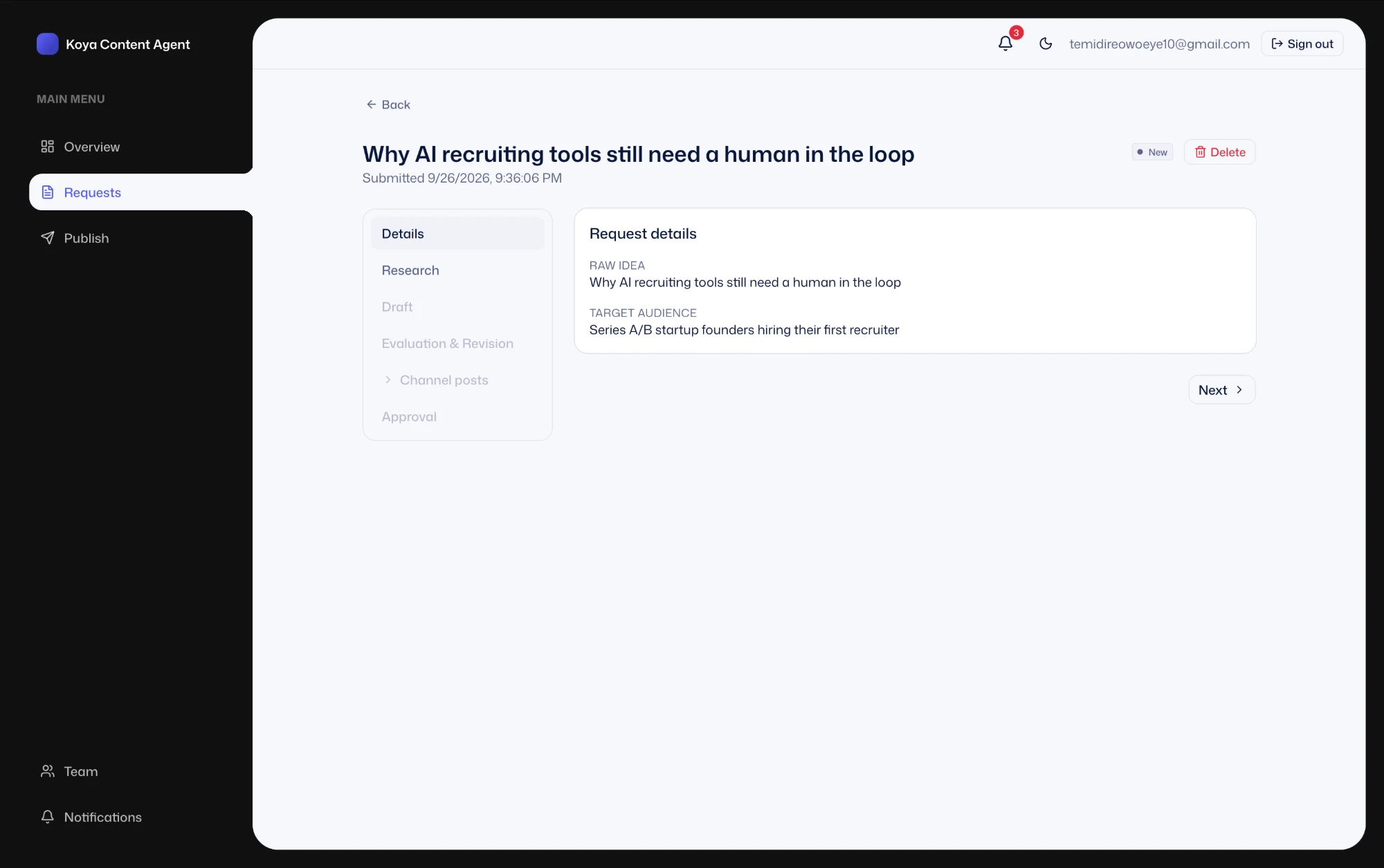
Submit an idea or a URL
A raw idea or a source URL, plus the target audience. Gibberish, unreachable links and paywalled or login-only pages are caught before anything is written.
Research and rank sources
Firecrawl searches the idea or reads the URL. Sources are ranked for relevance, and the member picks which ones the draft is allowed to use.
Draft with citations
Claude writes an SEO article where every claim is tied to one of the chosen sources, so the reviewer can see exactly what informed it.
Evaluate and revise
The draft is graded on tone, clarity, SEO fit, audience fit, completeness, topic relevance, source grounding and factual consistency. Weak sections are revised, up to three passes, with every version kept.
Adapt, approve, publish
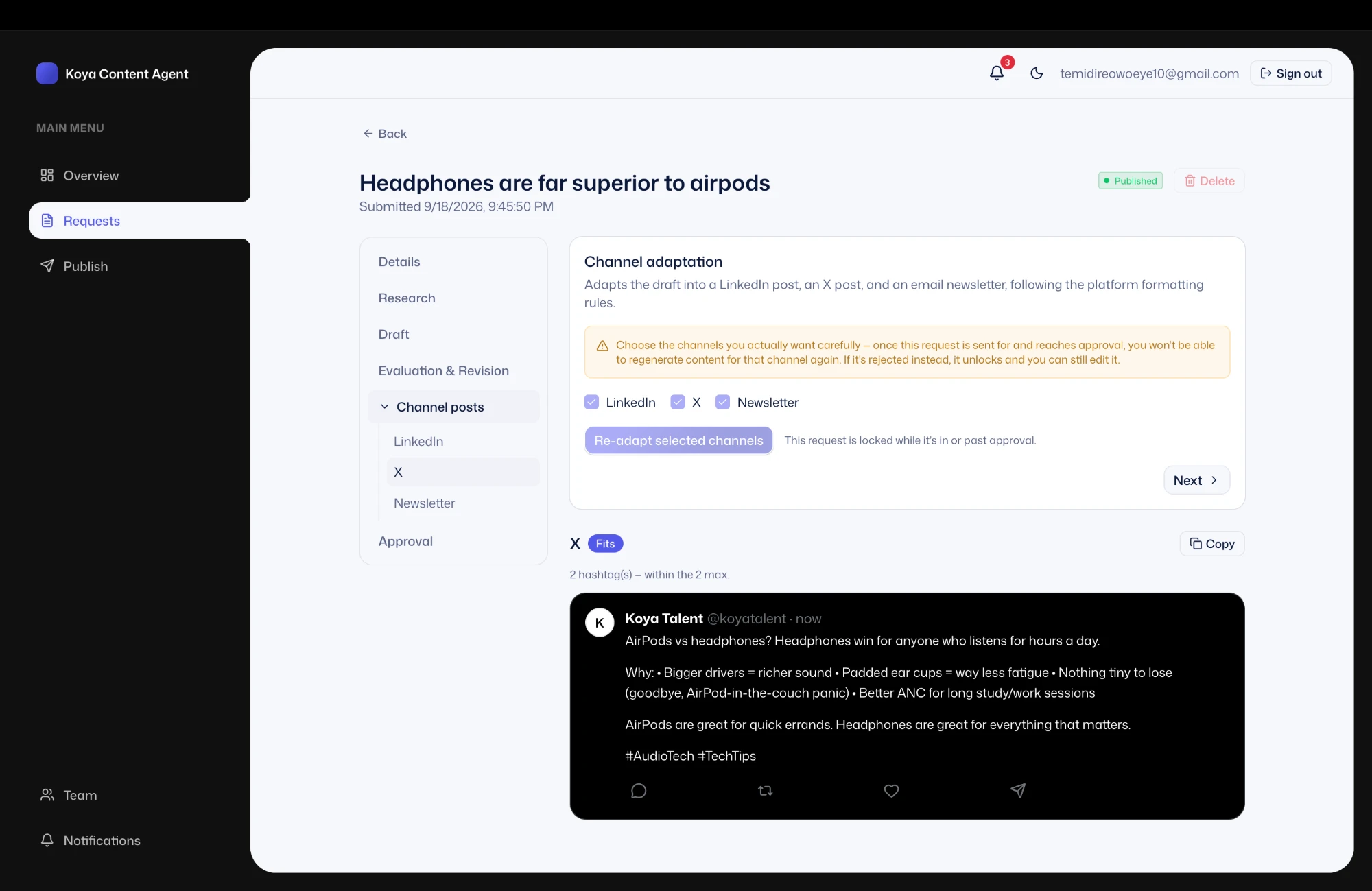
LinkedIn, X and newsletter versions are checked against each platform's formatting rules. Nothing moves until a person approves it, then it goes to a publishing queue to publish now or schedule.
04Before and after
Before
- Ideas researched by hand
- Articles drafted from scratch
- Each channel rewritten separately
- Quality and tone checked by eye
After
- Sources found, ranked and cited
- Drafts graded on 8 criteria, with version history
- Channel posts checked against formatting rules
- Nothing goes out until a person approves it
05See it run
06Proof it holds up
- Idea-only and URL-based requests both produce grounded drafts.
- A members-only URL that returned a login stub is now caught before a draft is written from it.
- Formatting checks flag posts that break platform rules, such as too many emoji on LinkedIn.
- Approval locks the request; comments go both ways between reviewer and writer.
07What I learned
I started by generating two article options per request. Carrying both through evaluation, revision and channel adaptation roughly doubled the cost of every later stage, for a comparison nobody used. Dropping to one draft with section-level revision made it cheaper and better.